
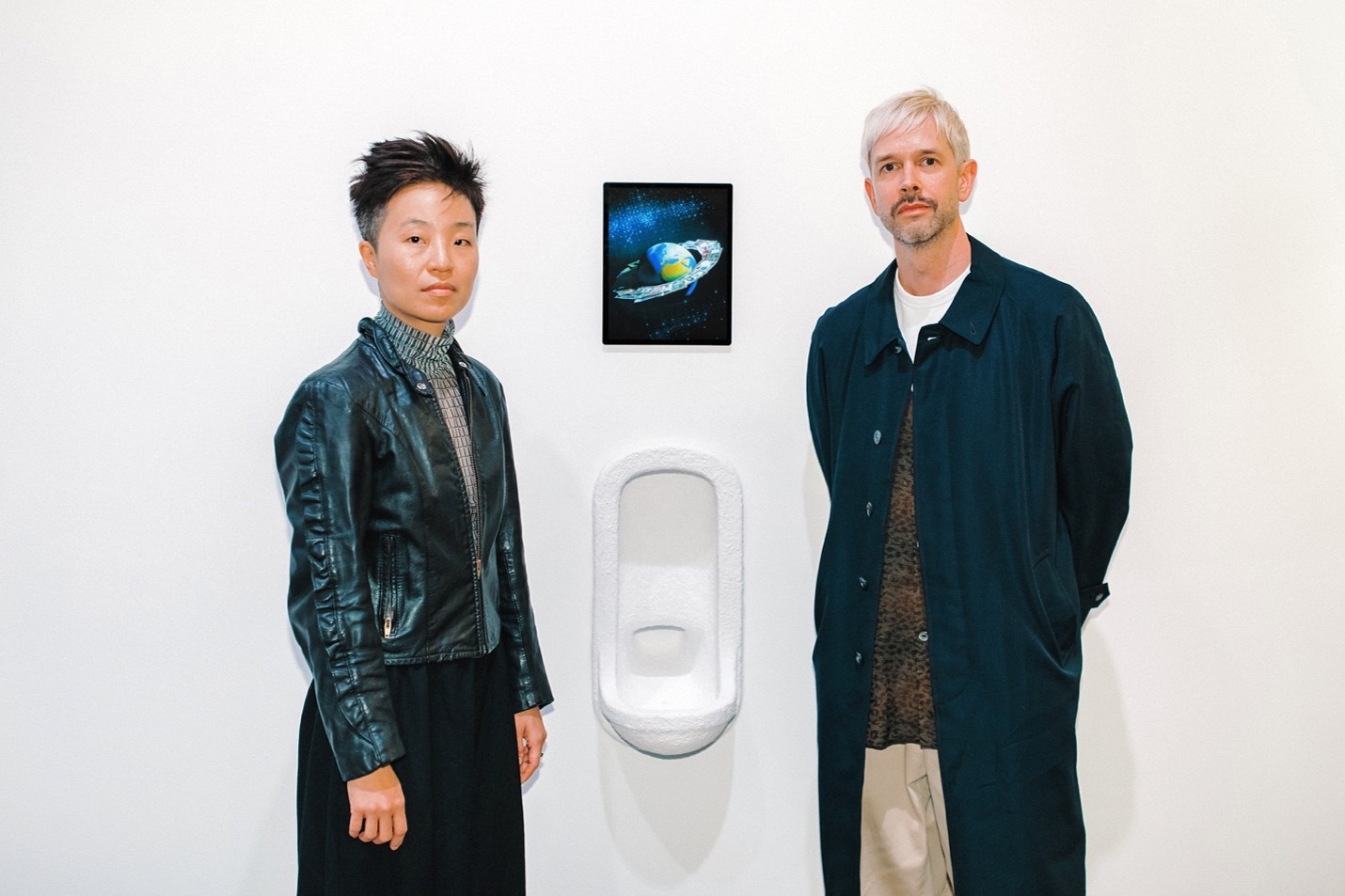
When asked what they hope students take away from their time at NSCAD, HaeAhn Paul Kwon Kajander, as they’re known professionally, don’t begin with technical skills, professional credentials, or career preparation. Instead, HaeAhn offers two words: curiosity and friendship.
For HaeAhn Kwon and Paul Kajander, who are co-chairing the Fine Arts Division at NSCAD in 2026/2027, curiosity and friendship are not distractions from success: they are the foundation upon which artistic lives and careers are built. “Good luck doing anything on your own,” Paul says with a laugh.
The image of the solitary artist working alone in a studio has never truly reflected reality. Artists rely on a complex ecosystem of peers, mentors, curators, technicians, writers, fabricators, collectors, and collaborators – even the people that manufacture pigments. Paul notes: “individualism and the cult of personality overlook the necessary relations that sustain creative work.” This statement is made without judgement of solo artists rather from a belief that artistic practice itself evolves from relationships, conversations, and the exchange of ideas.
That philosophy shapes HaeAhn and Paul’s approach to teaching. They view education as a process of inquiry and discovery. The studios where they “teach” are places where students are encouraged to ask questions, test assumptions, explore unfamiliar territory, and learn from one another.
During our conversation, some of HaeAhn Paul Kwon Kajander’s most animated moments are not about their exhibitions or professional achievements, but about observing students engaging with ideas. Paul recalls a recent class teaching first-year students about the complex legacies of minimalism with genuine emotion. He was moved by the insights students were able to realize while exploring this new-to-them material. Those moments of discovery are what continue to energize their work as educators.
Both arrived in Halifax four years ago following active careers practicing, teaching, and immersing themselves in the “art world” across Canada, the United States, Korea, and other international locales. When asked why they chose to come to Halifax, HaeAhn offers that NSCAD’s reputation for art pedagogy was attractive because it continues to offer something increasingly rare: a culture that places studio practice at the centre of learning. HaeAhn and Paul believe students need dedicated space on campus not only to exhibit finished work, but to inhabit the unpredictable and sometimes messy process of making art. “Seeing what your peers are working on as they are making it and not just as a finished artwork is hugely inspiring and demystifying.” As they continually remind their students “There are no shortcuts in artistic practice, you have to show up for yourself and for each other.”
As active artists, HaeAhn and Paul bring their experience directly into the classroom. Their practice keeps them connected to national and international artistic communities, exposing them to new ideas, evolving discourse, and emerging perspectives. Those connections enrich the student experience. Paul and HaeAhn argue that while they may be studying in Halifax, NSCAD students should never feel isolated disconnected from the larger world.
Embracing the local context, they speak enthusiastically about the advantages of building a creative practice here. While major urban centres may offer endless activity and opportunity, there are many distractions that can lure artists away from their studios. Halifax offers something different: a gentler pace and sharper focus to develop ideas, experiment, and build meaningful relationships.
HaeAhn and Paul speak less about their personal accomplishments, focusing instead on community: the mentors who offer guidance, the peers who challenge assumptions, the friendships formed in studios, and the collaborations that continue long after graduation. It is a perspective that feels especially fitting as they step into their roles as Co-Chairs of Fine Arts. Their vision is rooted not only in artistic excellence, but in the belief that strong communities foster stronger artists. Friendship creates the relationships, networks, and collaborations that sustain artists’ practices over time. This has been the foundation for their careers.
As an example of the power of collaboration to build community, the Franz Kaka gallery in Toronto that represents HaeAhn and Paul is marking 10 years of operation with a move to a new and larger space. For Paul and HaeAhn this growth is a significant achievement as they have observed that this is time of contraction in the contemporary art world – particularly the middle market. To celebrate the milestone, a new show – Soft Hardware – opened on September 16, 2026 co-curated by Anaïs Castro with several artists including HaeAhn Paul Kwon Kajander.
In a world that increasingly rewards adaptability, hands-on skills, and collaboration, Paul and HaeAhn live what they teach: that curiosity and friendship are among the most valuable lessons an art school can offer.