

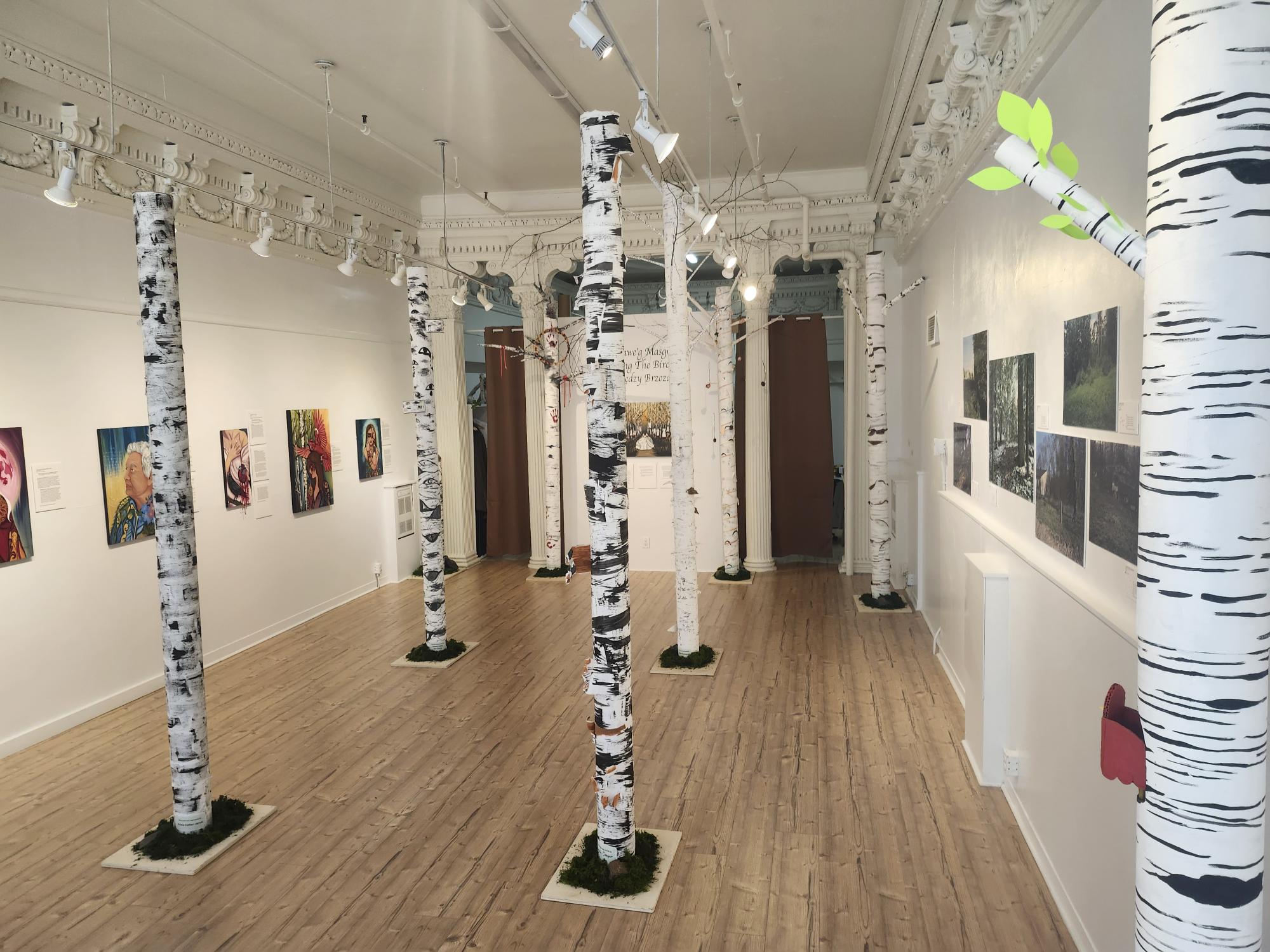
For those promenading on Granville Street, the Treaty Space Gallery might look more like a terrarium than an art space.
Last week, NSCAD University’s Treaty Space Gallery opened the highly anticipated group exhibition, Among the Birches.
Presented in partnership with the Two-Eyed Seeing Project at Mount Saint Vincent University, Dalhousie University’s Centre for Jewish Studies, and the University of King’s College, Among the Birches brings Indigenous and Jewish histories into conversation, intersecting the shared connection between memory, place and community.
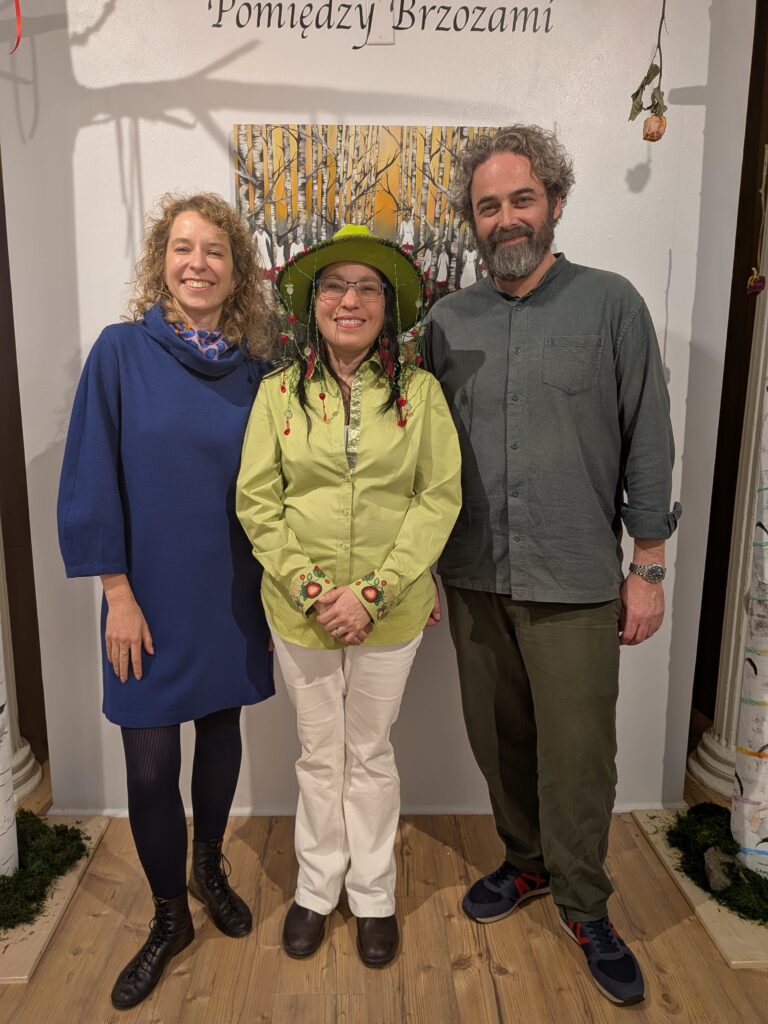
The exhibit brought together the works of Two-Spirit Mi’kmaw artist Jessica Jerome, and the Polish-Jewish Zapomniane (Forgotten) Foundation, represented by Aleksandra “Ola” Janus and Alexsander Schwarz. Through painting, photography, sculpture, and research, Among the Birches explored how art can be a tool for addressing and preserving difficult histories.
TREES AS A SITE FOR MEMORY
In preparation for the exhibition, Jerome led workshops with NSCAD and MSVU students at the Treaty Space Gallery, creating life-sized paper birch trees that transformed the space into an immersive installation. The trees act as a bridge for the two bodies of work, creating a shared physical space in which visitors can engage with the different approaches to memory and remembrance.
But for Jerome, the theme of birch trees hits close to home in the aftermath of a personal loss.
After the death of her older sister in early 2026, Jerome found herself retreating into nature—taking long walks along the waterfront and in wooded parks. The surrounding birch trees inspired her to process her grief through art.
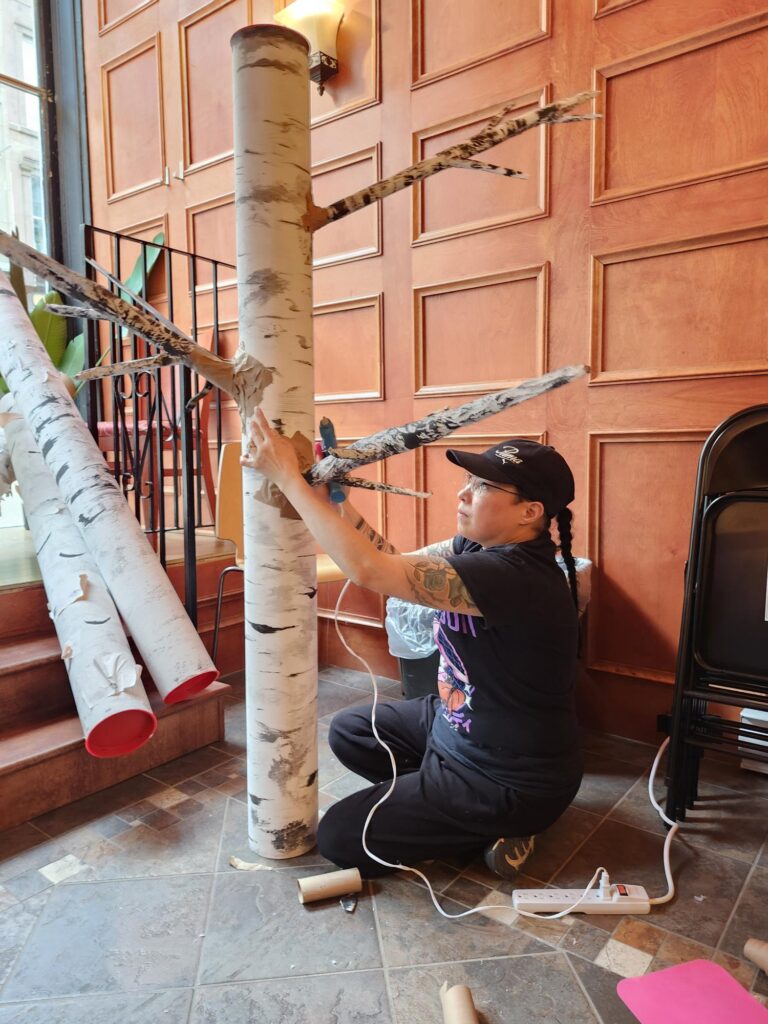
“These images of birch trees kept coming to mind, so I started painting them in the background of my art as a way to deal with losing my sister,” she said. “I take all those emotions, and I give it to the painting. I give it to the work, and I let it go.”
When Jerome was approached to create this exhibit with the Zapomniane Foundation, she noticed that birch trees frequently appeared in their work as well.
“When I met with Ola for this project, we realised that their photography has a lot of birch trees in the background of their images,” she said. “I found that very interesting, especially with their work researching memorial sites.”
The memorial sites in question are the hundreds of mass graves that Janus and Schwarz investigate as part of their work at the Zapomniane Foundation. Through fieldwork, oral history and geophysical research, the Foundation locates and documents mass graves in Poland and Central Europe, including sites associated with the Holocaust.
The result is a series of photographic documentation of these grave sites. A seemingly ordinary forest and overgrown landscape reveal a darker story—dotted with orange markers, GPS coordinates, and the number of victims to help viewers understand the violent history behind the photograph.
“For us, the trees act as a kind of material witness,” said Janus. “Sometimes people carve their names on the trees. Others use it as a point of reference when they’re lost. Or they are used like markers where people are buried. The trees become a source of information, and the landscape becomes an archive.”
ART AS A TOOL FOR DIALOGUE
Although the exhibition brings Mi’kmaw and Jewish experiences into conversation, the artists took special care to ensure one difficult history does not overshadow the other.
“Although we are coming from a different historical geography, we had to be conscious that we are on Miꞌkmaꞌki,” said Janus. “So, our approach for this exhibition was to offer a snapshot of a different reality and bring that into the conversation of difficult histories.”
For Jerome, she saw the exhibition as a way of expanding the conversation about Missing and Murdered Indigenous women, a reoccurring theme in her paintings.
“The imagery of the forest and photography of burial sites is very central to the story,” she said. “A lot of the equipment the Foundation uses to locate mass graves, we use the same equipment on sites of Residential Schools. The goal of the exhibition is to make sure we don’t forget what happened to these people on both sides.”
As an artist, Jerome sees art as a starting point to make difficult histories and stories more accessible to others.
“To me, art will always be the starter of dialogue,” said Jerome. “It’s a way of bringing people together. It takes away that intimidating factor of a sensitive topic and levels the playing field. Once people see the message, they start to spread the dialogue, and that’s how we encourage conversation.”
While art is not a substitute for historical research, for Schwarz it is a way to imbue life into a site of difficult history.
“Artists create a platform for people to connect with each other and with the place,” he said. “If you make a monument, but people don’t understand the story behind it, then it’s just dead stone. Art is one of the ways to connect people to the story. It not only preserves memory, but it can be a powerful tool for communities affected by trauma.”
Among the Birches will be on display at Treaty Space Gallery until Friday, November 6, 2026.