

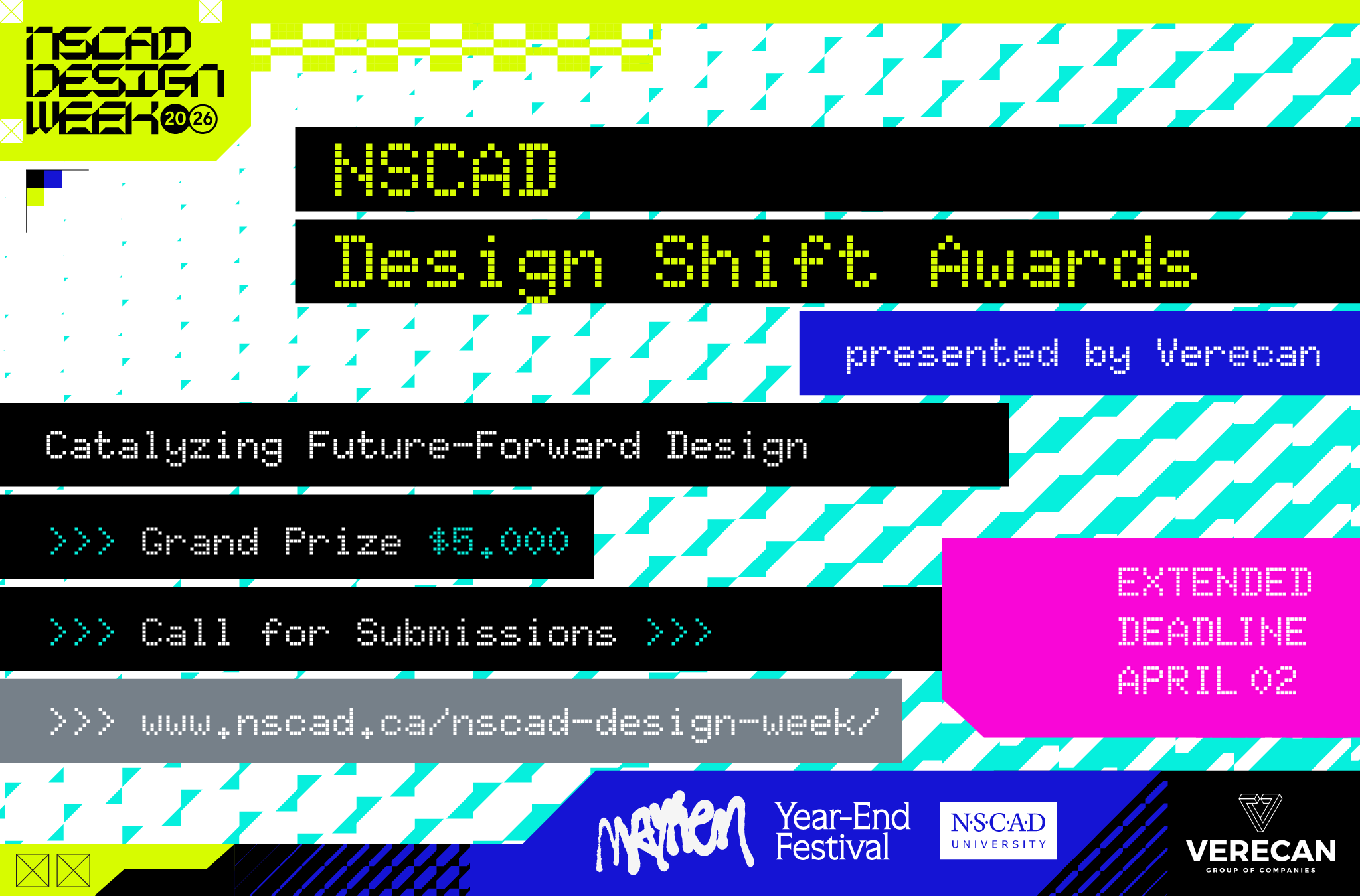
Are you ready to shift the status quo?
NSCAD Design Shift Awards 2026, presented by Verecan, are officially open for submissions!
Under the motto “Catalyzing Future-Forward Design,” we are looking for design that acts as an agent of change. Whether you’re designing for health and well-being (Thrive), providing human-centred design solutions to complex problems (Resolve), pushing the boundaries of design thinking and emerging technologies, or addressing speculative futures (Venture), your work deserves the spotlight.
Extended Deadline: Thursday, April 2.
Submit your work to designaward@nscad.ca.
Prizes and Awards
The Award Winners will be announced during NSCAD Design Week, April 27-30, 2026.
- Category Thrive: Winner receives $1,500.
- Category Resolve: Winner receives $1,500.
- Category Venture: Winner receives $1,500.
The Impact Award (Grand Prize):
The single most transformative project across all categories will be awarded $3,500 in addition to the category prize for a total of $5,000.
Our Jury

Shelagh McLellan is a UX Manager for Crisis Resilience and Climate AI at Google. In her prior role at Google, she worked on developer tools for public health apps in low resource settings. Prior to Google, Shelagh led multidisciplinary teams at IDEO, focusing on design strategy, service design and early product development. She has an MA in Interaction design from Umeå Institute of Design in Sweden, and a B.Des in Industrial Design from Emily Carr University in Canada.
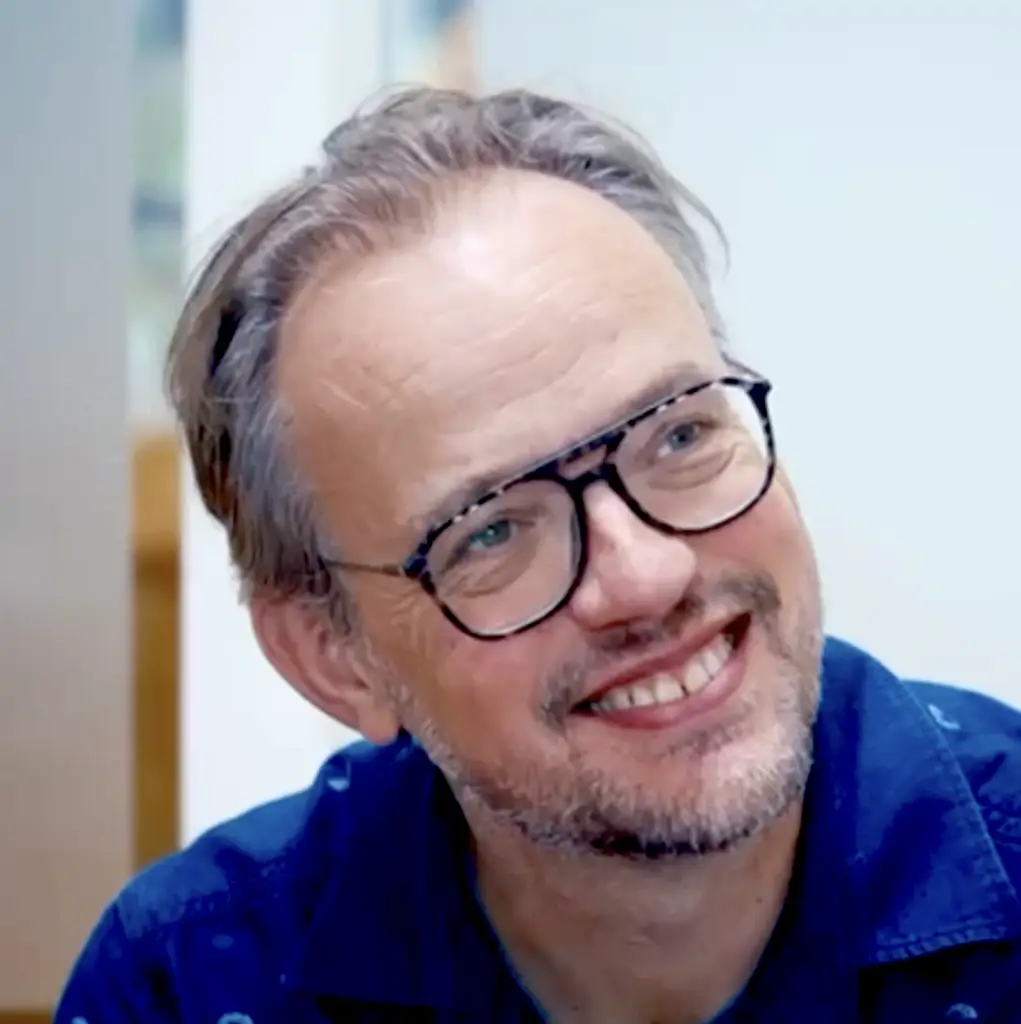
Mike de Regt is a Dutch Experience Director with more than 20 years of in-depth experience in multiple consumer and healthcare product categories and design competencies. He has a strong foundation in user interaction design, innovation design, and design for user experience. Mike believes in strategizing partnerships, hands-on design work, and leading cross-functional teams to design and innovate for users of Philips solutions.
Throughout his career, he has worked in various locations around the world and in multiple types of projects and roles. He was the Design lead for the Design Language System ‘Filament’, Experience Director for Philips’ Cross Platforms solutions, UX design lead for Philips Healthcare’s Hospital Patient Monitoring systems and currently leading the Customer UX for Philips’ Service solutions.

Lesley Palfreyman (BDes 2002) is a Principal Product Designer and research strategist leading scalable, human-centered experiences for complex problems. With over twenty years of experience working across voice, mobile, web, and multimodal device platforms, Lesley’s work has reached millions of global customers. Leveraging strengths in user research, ideation, end-to-end journey mapping, and storytelling, Lesley elevates customer needs and ensures design solutions deliver both customer and business impact.
Following the completion of the Communication Design Honours program at NSCAD University, Lesley worked for design agencies in Toronto, San Francisco, and Silicon Valley before moving to Seattle to accept a role as Senior User Experience Designer with Amazon. Over the next fifteen years, Lesley played a key role in transforming Amazon Music from an MP3 download store into a global, cross-content streaming service. Leading user experience for subscription tier launches, expanding the product internationally, managing a rebrand across teams and marketplaces, advancing voice design experiences, and evolving product strategy and research practices are among her areas of influence and impact.

Glen Hougan is an industrial/product and service designer with a background in user experience, product development and design thinking. He is principal of the design consultancy Wellspan Research and Design which offers design research and product development services and workshops in healthcare and design for an ageing population.
His research and work is in the area of design for health and ageing has been covered in everything from the New York Times to the Wall Street Journal. In 2012 he was awarded a research fellowship in Healthcare Innovations from the Center for Innovation (CFI), at the Mayo Clinic, in Rochester, Minnesota and in 2010 he was made the Sun Life Financial Chair in Design in Health and Aging. As well as a full-time faculty in the design division at NSCAD University, he is an Adjunct Professor at engineering at Dalhousie University.

May Chung is a professional design consultant and an associate professor of design at NSCAD University. She holds a Master of Graphic Design from North Carolina State University, Raleigh, North Carolina; and a BFA Majoring in Visual Communication Design, and BA General from University of Alberta, Edmonton.
Chung has received many grants including the Dreamscape Design Research Grant (2021), the Productivity and Innovation Voucher (2019), The Alexander Bell Foundation Design Research Grant (2018), the Industrial Research Assistance Program (2016), the Multicultural Association of Nova Scotia Experience Design Grant (2015), the Food Action Research Centre Design Grant (2015) and the Nova Scotia Department of Economic Development Grants (2003).
Award Categories
Submit your work (has to be done within the last 2 years) in one of the following categories:
- Thrive: Design for Health & Well-being
This category celebrates designs that empower individuals and communities to not just survive, but to flourish. It encompasses innovations in healthcare, mental wellness, accessibility, sustainable living environments, and any design solution that actively improves quality of life. “Thrive” speaks to the ultimate outcome of well-being, highlighting design’s vital role in fostering healthier, more resilient societies. It underscores NSCAD’s dedication to human-centric design that has a profound, positive impact on human potential. - Resolve: Human-Centered Problem Solving
At its heart, design is about solving problems. The “Resolve” category honors projects that meticulously identify complex challenges and provide elegant, effective, and human-centered solutions. These are designs born from deep empathy and rigorous inquiry, addressing pain points, inefficiencies, or unmet needs in any sector. “Resolve” emphasizes clarity of purpose and definitive outcomes, showcasing design’s power to untangle complexities and deliver tangible results, a hallmark of the rigorous design thinking cultivated at NSCAD. - Venture: Open Category
The future of design is uncharted. “Venture” is dedicated to the bold, the experimental, and the unconventional. This open category encourages submissions that push the boundaries of design thinking, explore emerging technologies, address speculative futures, or tackle interdisciplinary challenges that might not fit neatly into traditional classifications. “Venture” symbolizes the spirit of exploration, risk-taking, and foresight, fostering innovation that dares to imagine and create the next great “shift.” It reflects NSCAD’s commitment to nurturing pioneering spirit and groundbreaking research.
Rules
Categories and Prizes:
Each category will have one winner unless otherwise stated.
Impact Award (Grand Prize):
One Impact Award will be given to the single most transformative project across all categories. The Impact Award winner receives an additional $3,500 on top of their category prize, bringing the total to $5,000. The Impact Award is only available to an entry that has won its category; entries that do not win a category are not eligible.
Group or collaborative projects are accepted:
For administrative purposes, team entries must be submitted under the name of one designated team representative. All group submissions will be evaluated, judged, and rewarded on the same grounds as individual submissions.
Note: Multiple submissions are allowed.
Submission requirements
Submission Requirements
The NSCAD Design Shift Awards embrace the full breadth of our design community, inviting submissions from Undergraduate students, Graduate students, and Alumni who graduate within the last 2 years.
1. Projects must be submitted in a single PDF (multi-pages, maximum 10MB).
2. The submitted PDF has to be named in this order: Category_LastName_ProjectName.pdf
3. The submitted PDF should include:
- Title Page: Project name, category (Thrive, Resolve, or Venture), and student name.
- The Problem/Inspiration: A brief brief on what sparked the project
- Process Work:Sketches, prototypes, or research data that demonstrate the working and thinking processes that led to the result.
- Final Delivery: High-resolution renders, photos of physical models, or UI/UX screens.
- Design Statement (300–500 words): An explanation of how the project meets the specific criteria of the chosen category.
4. Interactive media: For projects that can’t be fully captured in a static PDF—like animations, apps, or websites—students can additional provide:
- Live Links: URLs to Figma prototypes, live websites, or GitHub repositories.
- Video Walkthroughs: A link to a 60-second “demo reel” (hosted on Vimeo or YouTube) that shows the design in action.