

by Ross Nervig
Leonard Paul is, in many ways, the embodiment of Etuaptmumk, or two-eyed seeing.
Two-eyed seeing offers a way of understanding the world through more than one lens. Mi’kmaw Elder Albert Marshall describes it as learning to see with one eye the strengths of Indigenous ways of knowing, and with the other eye the strengths of Western ways of knowing, and using both together.
Leonard Paul’s life and work reflect that approach in motion. For five decades, he has carried Mi’kmaw story, memory, and lived experience alongside a deep engagement with Western art history and technique. In works like Stony Dancer, a powwow figure meets the viewer with a piercing gaze. That gaze feels rooted in community and culture, yet shaped by years of studying surrealism, romanticism, and realism at NSCAD in the 1970s.
Raised off-reserve in Halifax, Leonard spent years navigating where and how his identity could live within his art. He began as a graphite artist, moved through acrylic, and eventually found his rhythm in watercolour, which he calls both his peace and his chase. Over time, the separation he once felt between fine art realism and Mi’kmaw story began to soften.
His exhibition, The Best of Two Worlds, speaks to that hard-earned blending. In this conversation, Leonard reflects on struggle, growth, imagination, and the slow confidence it takes to let both eyes guide the same canvas.
Looking back over five decades of practice, how would you describe your journey as an artist?
I got my start at NSCAD. I thought I knew a lot about art. Then art history hit me. We didn’t have art history at Saint Pat’s High School, so I had to go to the library and create my own kind of catalogue of artists just to catch up. That’s when I realized I didn’t know very much about art at all.
I started reading about Salvador Dalí and surrealism. I got hot on surrealism at art college and stayed in that realm all through my early years. The imagination was incredible — René Magritte, Dalí, Max Ernst. I had been drawing realism in Grade 9 and 10, and then I flipped the apple cart over and went straight into surrealism. Art history just exploded my brain.
I loved romanticism and art nouveau too—more than the studio courses sometimes. The slideshows every week, the professors getting their hands on you—that’s when I blossomed. We went to the Metropolitan Museum in New York. I saw paintings I thought were small, and they were huge. The Raft of the Medusa — all those figures are life-size. That opened me up in a big way.
I learned from the students, too. I was very introverted, but watching my classmates, I learned a lot from them.
After NSCAD, what did your career look like?
A good description is a carrot in front of you.
At the start, there were a lot of ups and downs — financially too. You can’t make your life depend on one cheque, one sale. If you put all your eggs in one basket, you’re going to be disappointed. I was disappointed a lot. You think someone’s going to buy the work — and they don’t. That was part of it.
I started as a graphite artist. My whole creative life began with pencils. Recently, I saw a master fine-art journalist on TV who said pencils are stepping stones. Looking back, he was right. I knew I wasn’t going to stay with pencils forever, but they were a launching pad into colour.
I moved into acrylics for about ten years. Then, mingling in that stage, I got into watercolours. That’s where I am now. Watercolour is my bread and butter — and my peace. I didn’t want to go further into oils or back to acrylics. Watercolour is the chase.
My significant other once said, “I’m not sure if you even like the piece at the end, but I know one thing — you like the chase.” And she’s right. When it’s done, I don’t really care where it goes. I’m looking for the next piece. The chase is what I love.
What do you remember most about your time at NSCAD?
I was going through hard times there.
Because I’m First Nation, I didn’t realize how much my cultural background made me awkward and extremely shy. In grade school, teachers would say we were studying “the life of the savages in Nova Scotia.” That shuts you up. That stayed with me like a coat I couldn’t take off.
So when I got to art college, and people wanted my opinions, I had a hard time expressing myself. My identity was strong inside me, but I was clammed up. I went through depression all through art college. I even saw counsellors there. It’s hard to open up when you’re clammed shut.
But the blossoming happened later. After art college, I went to Europe—the Louvre, the Tate. Again, it was art history. Studying, scrutinizing paintings. And slowly I shed that fear and depression. Art pulled me through. I stuck with it, and it got me out.
What does it mean to return to NSCAD now, exhibiting at Treaty Space Gallery?
It’s fantastic.
I had been out of the picture for a long time. But then I went back. Walking through the studios felt like I had just dropped off fifty years ago.
If it wasn’t for the administration and professors encouraging me, I don’t know if I would have taken the opportunity. But once I said yes, the impetus grew stronger. The staff welcomed me with open arms. I felt comfortable instantly. It felt like they were waiting for me.
The exhibition is titled The Best of Two Worlds. What are those two worlds?
For a long time, I stayed in fine art—realism—because that paid the bills. I was lopsided. My immersion in First Nations culture wasn’t showing in my art.
About 30 years ago, I started moving closer—painting hunters, canoe scenes, wildlife. I became almost a historian painter. Then something important happened. I was given an original copy of Silas Rand’s Micmac Legends. A non-Aboriginal man told me he didn’t feel right keeping it. He drove to my house and gave it to me.
I read those stories—hundreds of years old—and interpreted them my own way. Around that time, The Lord of the Rings came out. I had dragons and mythic figures in my work. A school bus of First Nations kids came to see the show. One of the kids asked, “We had those in our legends?” I told them, yes — we don’t have to look to Hollywood. It’s in our own stories.
That was powerful.
So the two worlds are fine art realism and First Nations story and imagination. For years, I leaned one way, then the other. Now I’m blending them. That’s the best of two worlds.
Can you describe your creative process?
This is something I don’t often say.
I don’t use sketchbooks. I have about 30 of them—empty. I create everything out of my head.
I read a legend, but I twist it. That’s what imagination is about. I don’t want to be tied down by the isms. When I start, it’s like I’m floating.
I grew up hunting with my father. When he’d be waiting to shoot a deer, I’d trail behind him, making up stories. I still do that. Now I walk with my dogs. I see a raven. I make a mental sketch and take it home.
In watercolour, if something doesn’t need to be filled in, I don’t fill it in. I don’t use grids. I rely on my eyesight and my brain. It’s very pedantic. It’s the chase.
What advice would you give to emerging artists?
Tap into your inner being.
There’s so much technology now—apps, programs — and they can mould you. If you can free yourself from interruptions and rely on yourself, that’s important.
I had a young student say to me, “I’ll never be as good as you. You must have sat for hours drawing when you were young.” I said yes, I did. She said, “I can’t. There are too many interruptions.” She was aware of it, but couldn’t free herself. That’s profound.
You have to create space for the work.
And specifically for emerging Mi’kmaw or Indigenous artists?
Give yourself a chance.
I grew up off-reserve in Halifax. The only brown people I saw were my own family. For years, I didn’t blend my culture into my art. Later, I went into First Nations communities, taught art, and learned language from the kids. We laughed a lot. In reserve classrooms, the chairs are in circles. That changes everything.
If young artists allow the art itself to manifest—without feeling they have to choose one world or the other—they’ll have choices. For me, it took years. Now I’m mingling the two together.
That’s the best of two worlds.
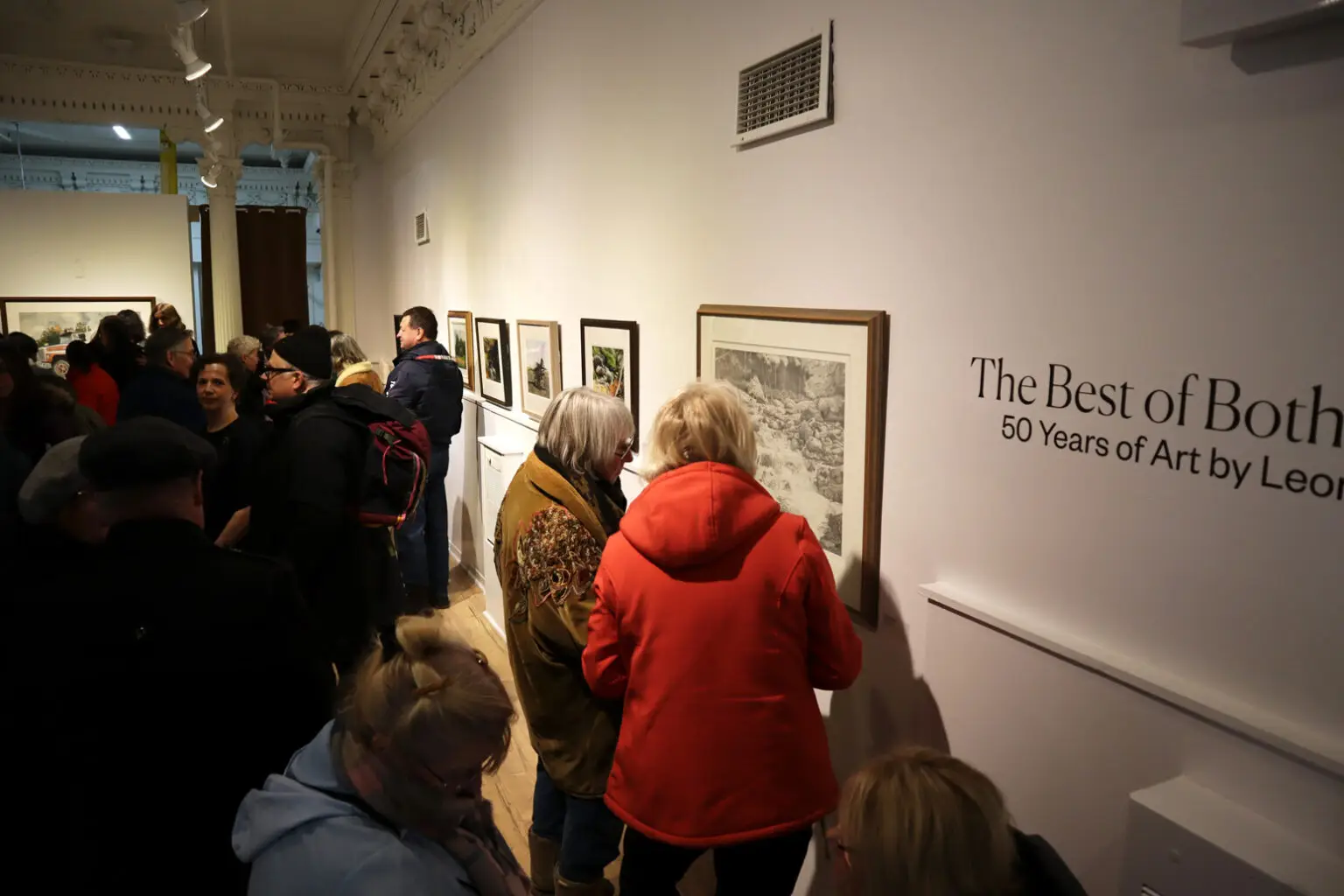
The Best of Two Worlds runs from March 2 to 21 at the Treaty Space Gallery, 1887 Granville St