

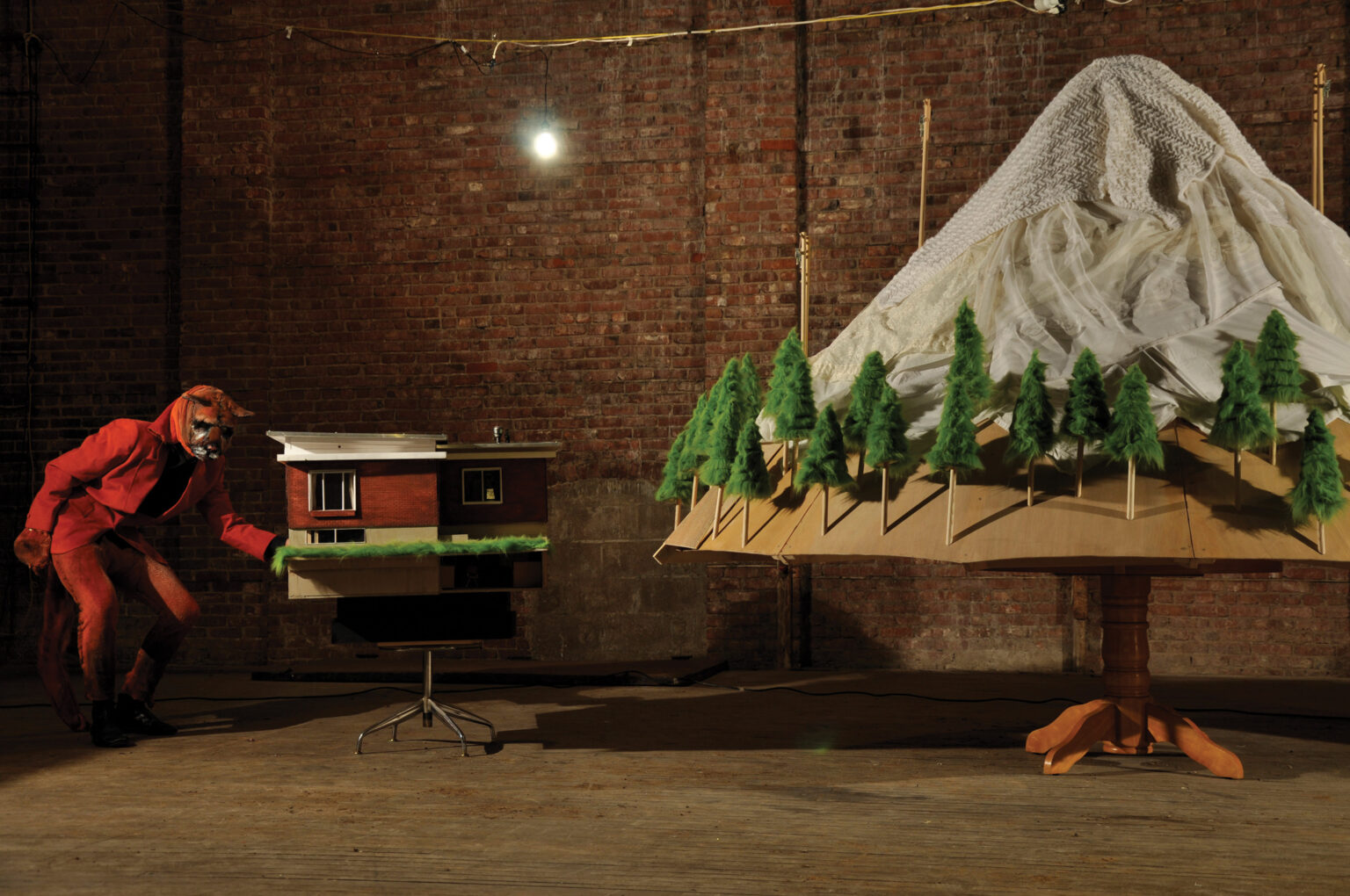
One of Graeme Patterson’s first stop-motion animations was a deer, roughly hewn with wispy fur. The curious animal serves as narrator for the Sackville, New Brunswick, artist’s 2007 installation Woodrow, an ambitious mixed sculptural and video work that envisions the real-life village of Woodrow, Saskatchewan, as a deceivingly abandoned town inhabited with lingering memories and other worldly spirits. The national touring exhibition of Woodrow, curated by Ray Cronin (BFA 1987) for the Art Gallery of Nova Scotia, garnered Patterson his first of three Sobey Art Award nominations.
After returning to some of his early work this spring, Patterson, who graduated with a BFA from NSCAD University in 2003, decided to create a new animated deer. “I’m going back to it with a whole other level of understanding, with technical advancements and new eyes,” he says.
In the original Deer and Monkey animation from Woodrow, which was acquired by the National Gallery of Canada for its permanent collection, Patterson captures the animal’s inquisitive, playful side as it leaps around with a literal monkey on its back. His circa-2025 deer runs in place with the taut strength and power of Eadweard Muybridge’s horses. The animal is slick and muscular, but there is no doubt that this is one of Patterson’s creatures. It demonstrates his thoughtful process and curiosity, and how he employs technology to serve a greater artistic vision.
Patterson weaves many disciplines, such as sculpture, robotics, virtual reality, costume design and music production, into immersive projects that often touch on the personal but are universal in their explorations of memory, nostalgia and connections to the natural world. But stop-motion animation was Patterson’s primary area of study when he arrived at NSCAD back in 2000, with Woodrow already on his mind as an homage to his late grandfather.
Before making the move to Halifax, Patterson completed his foundational courses at the Dundas Valley School of Art, followed by a year of studies at the University of Saskatchewan in his hometown of Saskatoon. Once at NSCAD, he leapt into an independent studio practice under the guidance of a formidable trio of instructors: Rita McKeough (MFA 1979), Michael Fernandes and Jan Peacock.
“They each had their different way of teaching,” says Patterson. “At the same time, they let me focus what I wanted to focus on with the stop-motion animation.”
Listening to Patterson speak about his three years at NSCAD, one can imagine what these fond memories might look like transformed into one of his animations. Perhaps there’s a dissection of the Duke Street campus so that viewers could peer inside and watch a tiny version of Patterson hanging out with other artists. Maybe they’re in a studio, outfitted in costumes, engaged in a dance battle. Or perhaps he’s consulting with McKeough, a fellow multi-disciplinary artist who later would become a mentor and collaborator.
Beyond the studio, Patterson became involved at NSCAD and in the local arts scene, an approach he recommends for new students. A self-proclaimed social butterfly, he joined the student union, organizing dance parties and working with bands; skills he still uses today as an artist and as a board member at Sappy Fest, Sackville’s beloved summer music-arts festival.
“I am still activating within an arts community”
Although he may have arrived at NSCAD with a singular focus, Patterson found inspiration in his fellow students. “I pretty much met most people going to the school at the time in different departments, whether it be jewellery, or craft and ceramics, or painting, sculpture and design,” he says. “It was really great in terms of being able to bounce ideas off people and share different ways of making things. I thought that was super special.”
One of the artists that Patterson met during his time at NSCAD is Mitchell Wiebe (MFA 1996). The two share a similar sensibility, absurd yet sincere, and a mutual affinity for glittery animal costumes. G.L.A.M Bats, their most recent musical partnership, morphs depending on the event. Sometimes it’s a lounge-comedy act, other times it’s a rock musical or a karaoke night, but there’s always uninhibited creativity and playfulness.
“Music has always been a part of my life,” says Patterson. “I’ve always liked to play the piano and to perform or make music. And then when I started making animations, they naturally required music.”
In March 2011, Patterson added a JUNO nomination to his many accolades. His cover for the Halifax band Wintersleep’s album New Inheritors was named a finalist for Recording Package of the Year. The image is pure Patterson: a dioramic scene of a junk-filled alleyway guarded by a scrappy dog with a downturned mouth and glaring dark eyes. More recently, Patterson created animated music videos for The Burning Hell, an indie band based out of Prince Edward Island.
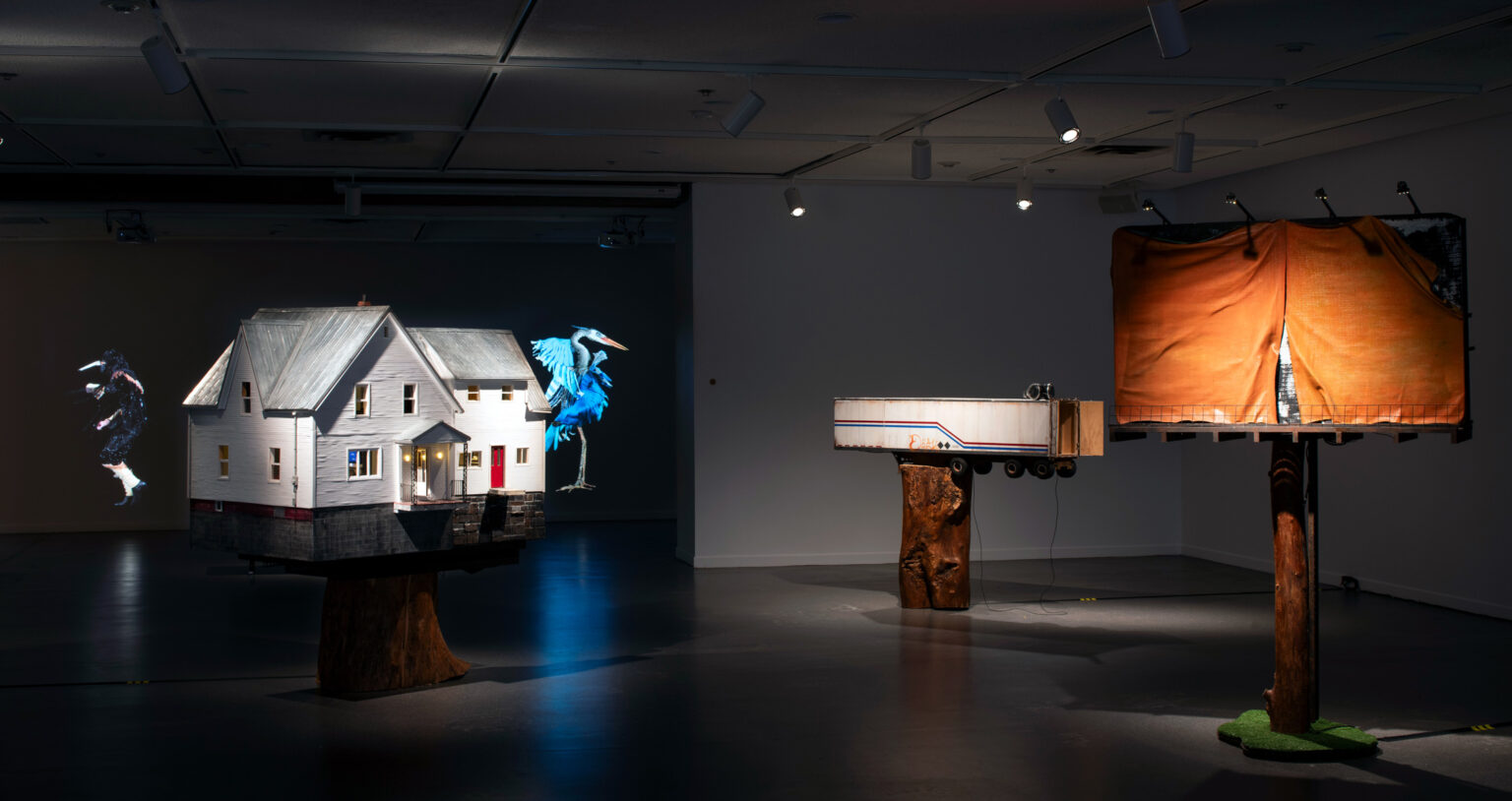
Music plays a key role in his latest multi-disciplinary exhibition, Strange Birds, co-organized by Beaverbrook Art Gallery and Dalhousie Art Gallery, which explores contemporary eco-anxiety through a fantastical narrative about a gentle heroic heron and a flock of invasive “Space Disco Starlings,” who begin to destroy the environment with their demands for food and land. Like Woodrow and his 2013 show Secret Citadel, Strange Birds started with a personal memory: here, a 60-foot tree which fell upon Patterson’s house just outside the Tantramar Marsh.
Strange Birds sees Patterson pushing his technological and musical-composition skills even further. In addition to a video game where players can control the Space Disco Starlings’ dance moves, Patterson created an intimate virtual-reality experience where viewers can drop inside the model of his home, fulfilling a long-time desire to open up his miniature worlds. He composed an ambient piece for the VR installation, hoping that it would have a calming effect while viewers roam this strange house. The music also doubles as a soundtrack for a 30-minute film that accompanies the exhibition.
While personal narratives and world creation have always been part of Patterson’s work, these days he is experimenting with more abstract ways to tell stories. He has been thinking about modes of storytelling that bleed more into poetry to communicate more about his present feelings, rather than starting with a look back.
That doesn’t mean that he’s abandoned nostalgia all together, at least where his time at NSCAD is concerned. Patterson’s final piece of advice for students: “This is the time in your life where you have the time and headspace to take it all in and hopefully keep your ears open and listen.”
Follow Graeme Patterson on Instagram or visit his website.