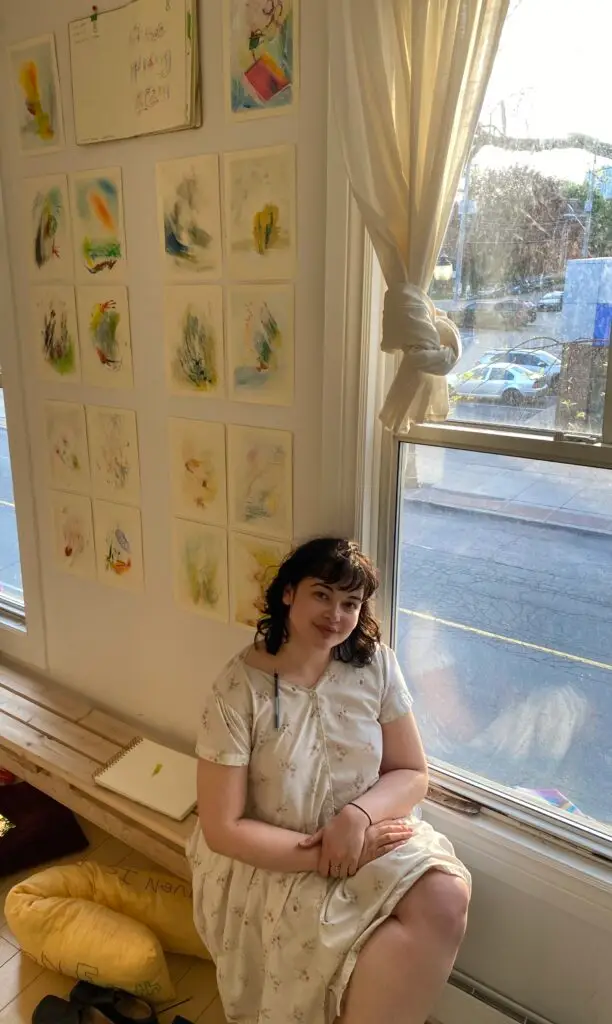

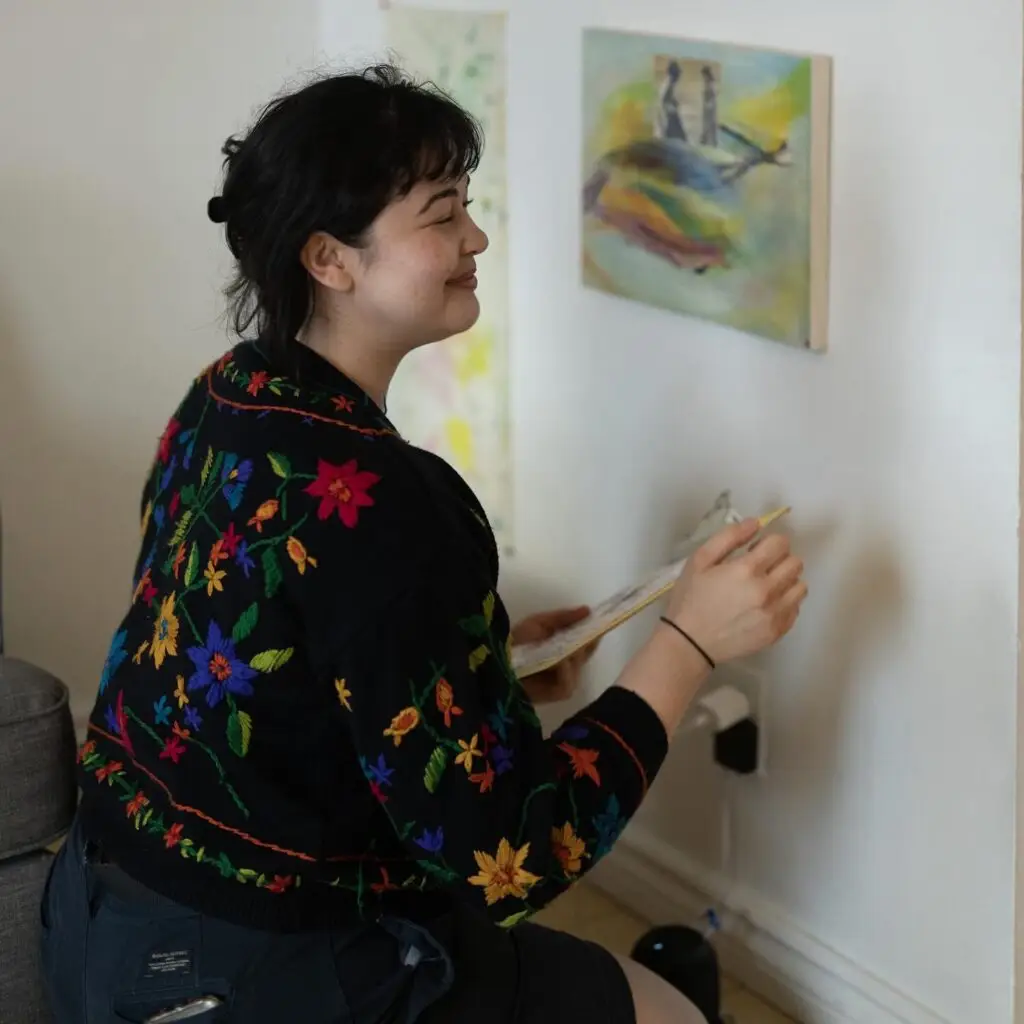
Carmella Dolmer is a painter, sculptor and organizer with roots in both Hamilton, ON, and Bicol, Philippines. She completed her foundation year at the Yukon School of Visual Arts before coming to NSCAD University to complete her BFA in Fine Arts.
Dolmer creates colorful abstract paintings and sculptures, writes and performs prose poetry, and organizes workshops in art spaces big and small. Her main practice is centered around incorporating play into her work.
As NSCAD University’s 2026 valedictorian, she reflects on her artistic journey, the lessons she’s learned, and what lies ahead.
Q: Tell us about your art journey?
Even though I’ve always been creative, I didn’t practice visual art in any meaningful way, aside from writing. After high school, I didn’t really know what I wanted to do; I worked in restaurants, bars and other serving jobs.
Then COVID happened and we were in lockdown, and for the first time in my life, I had full control over my schedule. I had to figure out how I wanted to fill my days and started gravitating towards the things that made me feel good and made me feel fulfilled. I just naturally started doing little drawings, which turned into paintings and eventually developed into a really rich creative practice.
Q: What was your reaction to being named valedictorian?
It honestly didn’t feel real until they asked whether I wanted to put my name forward for my peers to vote for me, and in that moment, I felt a lot of dread because suddenly I was in competition with my peers and I didn’t like the way it made me feel. I’ve spent a long time trying to pull myself out of the expectation or pressure of proving my artistic practice to others. It took me several years to develop the practice of pursuing play and intuition in my art, rather than wanting it to be good or impressive, or approved by other people.
But I feel immense honour to be recognized and chosen by my peers. It has been a process, but I am so grateful.
Q: Who were your biggest influences during your studies at NSCAD?
Two professors really shaped my experience at NSCAD.
My advanced painting teacher, Kizi Spielmann-Rose, really encouraged me to let go of anxious perfectionism in my work, and unlearn the conventional standards of art-making in order to tap into a sense of play. When I inquired about incorporating play into my work, I was expecting him to stress the professional standards required, but he encouraged me to experiment with a lot of materials and art styles. I developed the sense that art doesn’t have to be “perfect and precious” every time, and he really helped me hone that ability.
The next person is Dr. Carla Taunton. She was a huge influence on me and helped hone my skills in curatorial work and public programming. I want to create and host accessible workshops in my community like she does. She’s deeply engaged in radical, grassroots approaches, and is just an incredible mentor.
She and Kizi are some of the people that I wish to be as soon as I can.
Q: In what ways have you changed or grown during your time at NSCAD?
I think I was very lucky to be in certain classes where the professors were very open to my desire to pursue free play as a personal thesis.
Leading into my time here at NSCAD, I had these notions that were baked into me about what art needed to look like, or what you had to be doing in order to create it. Then slowly but surely, I learned about this huge richness of history and culture where I could suddenly draw examples from people doing very abstract or alternative modes of creation. That inspired me and also provided a framework for how I can lean into my own desires and instincts as an artist.
Leaving NSCAD, I now have the sense that I can validate all kinds of work and really consider all kinds of work as works of art, where I couldn’t really do so before.
Q: What’s the most valuable thing you’ve learned outside the classroom?
I’ve always been very preoccupied and anxious with my own performance in school and in anything I have done.
I went into NSCAD very perfectionistic and self-critical, which always prevented me from doing things like going to events and hanging out with friends. I was always so drained and exhausted by that perfectionism—and I was really just starving myself in other areas of my life other than school.
So, I made a personal goal for myself and tried to detach more from this perceived sense of high performance and to embrace things more organically. I have been able to rest more, randomly go out with my studio mates after a long day of critiques, volunteer at the Food Bank, basically do more things outside of just school and home.
I am really grateful for that experience, and because I saw that being modeled for me by my peers, it was something that could slowly incorporate into my life. I’m still working on it, but I’m much closer than I was when I started.
Q: If you could go back to your first year, what advice would you give yourself?
To go to every Anna opening and Treaty Space opening!
I’ve been so touched by other people’s ability to show up for things that I’ve done. There was this sense of community care and compassion that really floored me. It makes you feel so seen and appreciated when people show up to things that you do. It’s such a special feeling and I wished I prioritized that more for other people.
I would tell myself to go show up for your peers and classmates, even when you are exhausted or anxious. To try to develop meaningful community bonds in those ways.
Q: What can we expect from your valedictory speech?
I’m really trying to balance two things that I am feeling.
There’s this awareness over the years of a lot of tension between the student body and student union, and the NSCAD institution itself. So, I want to look back on how that time has been for our class and also show appreciation for all the people that have generously volunteered and sacrificed their time to doing student union work, and socially conscious public programming.
I want to try and acknowledge those two things without being confrontational on the day, but would still appreciate and call out to those efforts. I want to hold both of those feelings at the same time.
Q: What do you hope people take away from your speech?
That we’re all inherently creative, adaptable, and capable—and that the most meaningful growth happens when we come together, not in isolation.
Q: What’s a fun or unexpected fact about you?
I never learned my times tables. I somehow figured out a way to avoid it when I was in elementary school, but up until today, I still can’t do 4 × 7.
Q: What are your plans after graduation?
I’m moving back to Hamilton and hoping to work in galleries, art institutions, or artist-run centres. I’m really interested in curatorial work and creating accessible, community-based programming.
Q: What excites you most about the future?
That we can learn how to do anything—even if we think we can’t or it feels difficult or impossible. We can learn how to do pretty much anything, and that excites me.
Q: Do you have any advice for younger students?
Don’t compare yourself to others.
Something that took me a long time to learn is that all the people I was intimidated by or think are cool and talented or smarter than me, they are just trying their best as well.
You are no better or worse than anyone else, and no one is better or worse than you—we’re all just figuring things out. That mindset helped me a lot.
Q: Any final thoughts?
Just gratitude. For my classmates, professors, and all the staff who make the school run. From the librarians, all the way to the custodial teams, thank you for everything.
Carmella Dolmer will be addressing the graduating class of 2026 in a valedictory speech at NSCAD’s Convocation ceremony on May 12.