

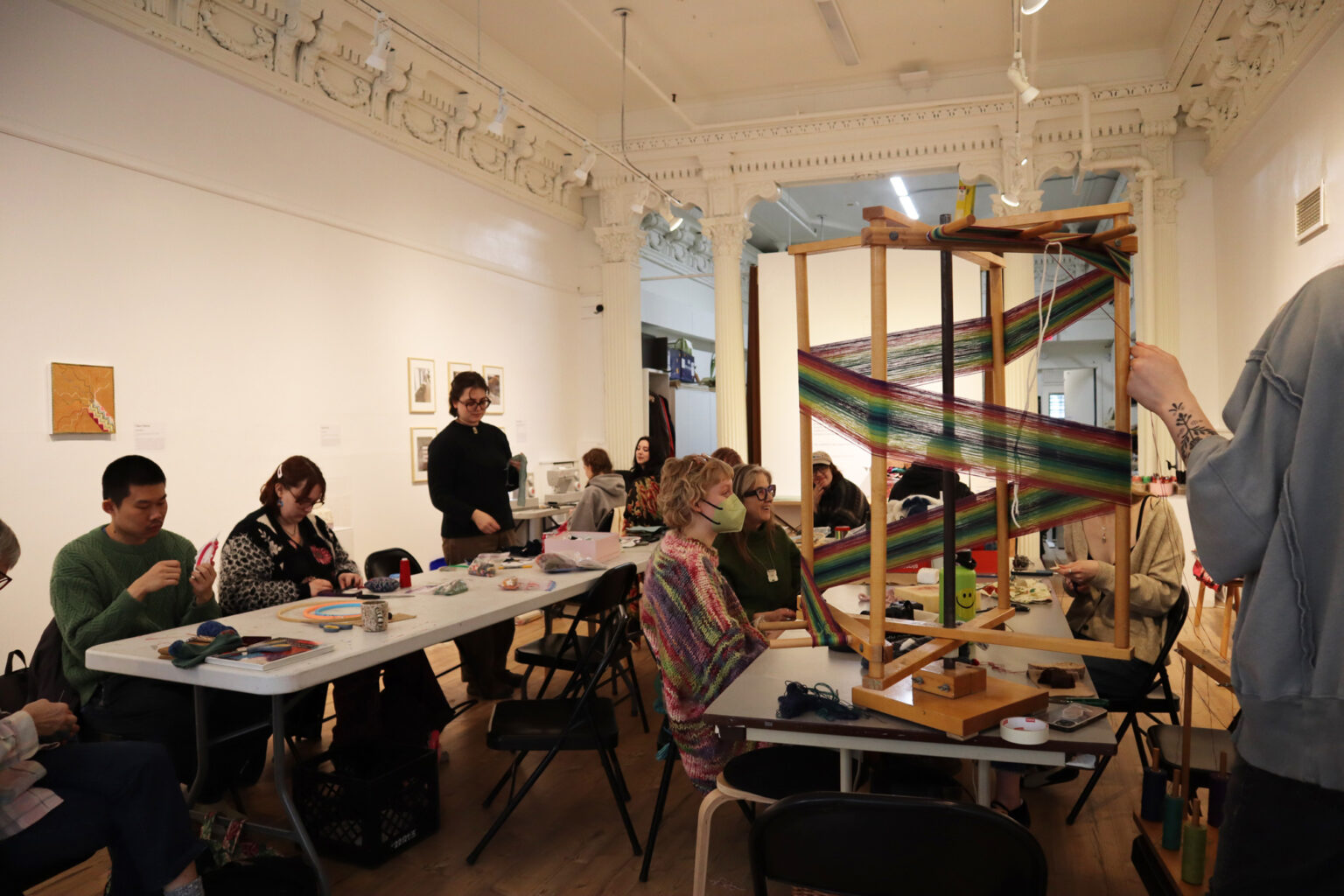
At Treaty Space Gallery, something is taking shape slowly.
Not just an exhibition, but a way of being in a gallery. A way of working together. A way of paying attention.
Wintering: The Art of Radical Slowness, developed by students in NSCAD University’s Radical Curating class, resists the typical timelines of exhibition-making. There’s no single opening moment where everything is fixed and finished. Instead, the space unfolds over time, through installation, workshops, and performance. Visitors arrive not only to see, but to sit, to gather and abide.
“In this course, the main work is to actualize a curatorial project,” says Dr. Carla Taunton, who leads this course. “In this past student curatorial collectives have curated everything from performance series to exhibitions to interventions, thinking through non-conventional curatorial practices, but also thinking through collaboration.”
This year, that collaboration began with a shared question. What might it mean to “winter” together?
“Working in collaboration with intention and care the students have considered a range of potential themes and questions,” Taunton says, “and landed on this idea of wintering.” From there, the class worked collectively to shape not only the theme, but the responsibilities that come with presenting work in Treaty Space Gallery. “They’re thinking about responsibilities to the concept of treaty, as well as to each other and to the land.”
Rejecting the pressure to be fast, productive, and constantly consuming
For third-year student Elle Haakonsen-Kincaid, wintering is less a metaphor than a shift in orientation. “Personally, I think wintering is about humanizing,” she says. “Giving grace to people, removing shame, and allowing yourself to experience life based on how it actually feels in your body.”
That shift pushes against the conditions many students describe as constant and exhausting. “It involves rejecting a lot of what current society asks of us,” she continues, “especially the pressure to be fast, productive, and constantly consuming.” At the same time, she notes the limits of that refusal. “Many people don’t have the privilege to slow down in other parts of their lives because of financial realities.”
In the gallery, they’re making room for that to happen. “It feels important to create a place where viewers can slow down, stay a while, and interact, or just be.”
That emphasis on being, rather than simply viewing, shapes the structure of the exhibition itself. Before the work is fully installed, the gallery is activated through workshops and informal gatherings: a mending workshop, print sessions, and performance nights bring people into the space as participants.
“The first week focuses more on the experience of being in the gallery without the completed artworks,” Haakonsen-Kincaid explains. “It establishes the gallery as a place to be, not just a place to view.”
As the days pass, the exhibition gradually fills in. Works are installed in stages. Equipment is moved. Layouts shift. Nothing is locked too early.
For third-year student Lydia Leblanc, that flexibility changes how decisions are made. “It allows us to let the space speak to us,” she says. “We can move things as we go. For example, placing a screen lower so it’s more accessible, or shifting works because it makes more sense in the moment.”
They’re figuring it out in real time. Moving things. Trying them. Seeing what actually works once people are in the room.
‘Curating feels like a different art form’
The process also reshapes relationships within the group itself. What might typically be dismissed as a difficult group project becomes something else, something magical.
“There’s often a resistance to group work,” Haakonsen-Kincaid says, “but working as a class and making collective decisions has shown how much a group can hold.” That shared labour has its own texture. “You see how people think, what they notice. It fills in gaps in your own understanding.”
Leblanc describes a similar shift. “Seeing how everyone works and what they bring—it builds appreciation. These are people you could collaborate with in the future.”
If curating is often understood as selection and arrangement, here it begins to look more like storytelling. “Curating feels like a different art form,” Haakonsen-Kincaid says. “It’s about directing the viewer through a space, like an author guiding a reader through a book.”
That story, in Wintering, is still being written as the exhibition unfolds.
For Taunton, this is an experiential learning process and opportunity. She says: “They’re building and creating it together.”
This past winter has set the tempo. The exhibition follows it. It puts gathering first and lets looking happen on its own terms.