
On March 23, the anticipation was palpable in the printmaking workshop as several boxes of freshly arrived etchings were opened by Professor Mark Bovey.
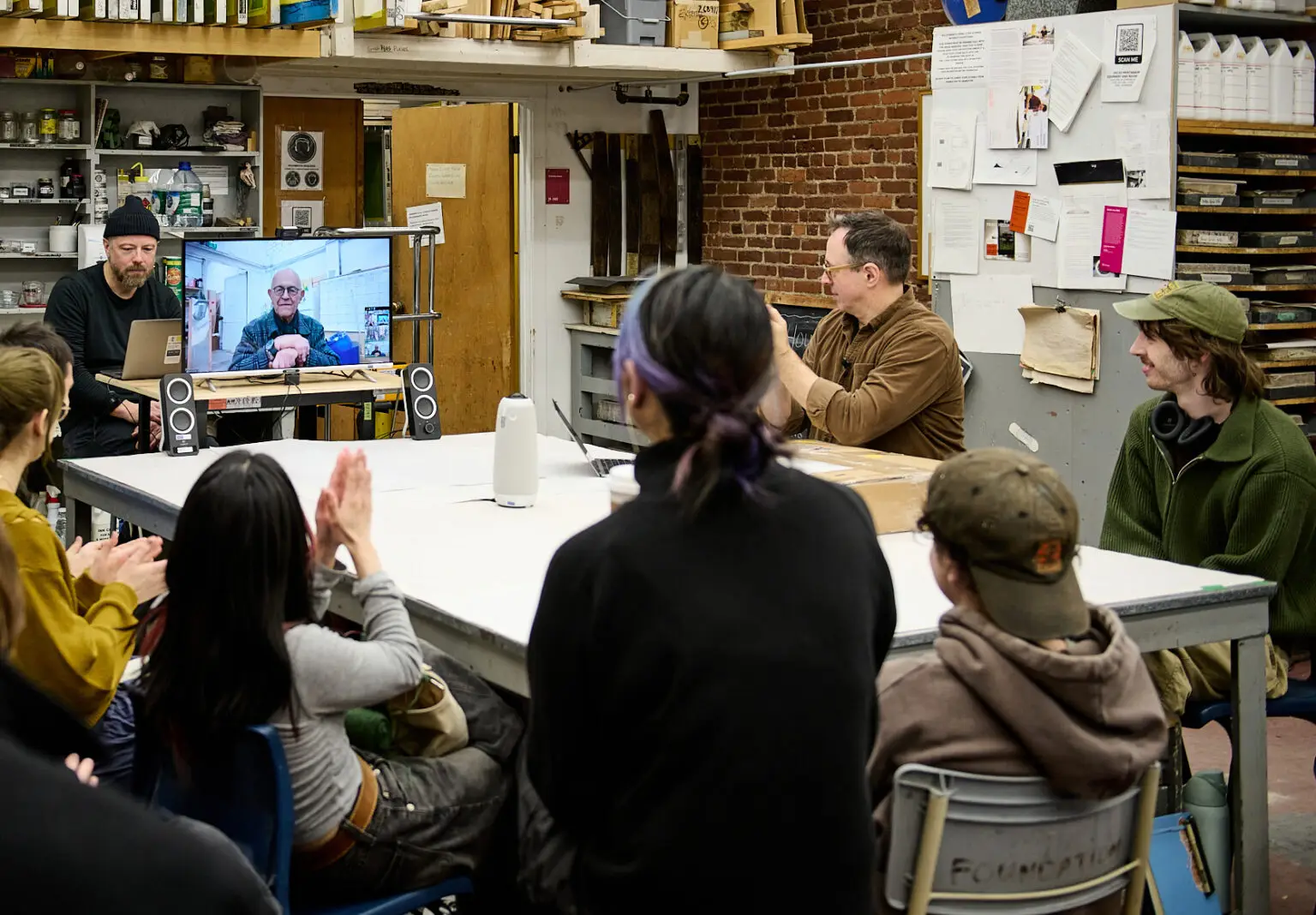
This rare gift – 55 etchings from the celebrated American artist Jim Dine – was officially received at NSCAD before a classroom of printmaking students on a video call with the artist himself, his studio assistant Daniel Clarke, and archivist Jeri Coppola in New York.
Bovey carefully took out each print and passed them to his students, who held and examined the works up close, taking turns to ask Dine questions about his artistic technique and practice.
“The students were initially quite nervous, but they warmed up after seeing a few prints. It isn’t every day you get to meet someone of Jim’s stature and then be asked to discuss his work in real time,” says Bovey.
Rather than hiding in an archive, this in-kind gift (worth $71,000 USD) from the Jim Dine Trust is intended to be used in classrooms as a teaching resource. This collection will be an invaluable instructional tool for printmaking students, says Bovey.
“This donation will appeal to students for generations to come because the work involves drawing, the direct touch of the artists’ hand; it also reveals the artists sense for experimentation, erasure, repetition and reinterpretation in the development and experimental approaches to the subject and to the ways of executing and printing the images.”
Jim Dine: one of the most prolific, talented artists of his generation
Jim Dine is a sculptor, painter and printmaker who works in intaglio (etching and direct gravure), lithography, woodcut & letterpress, Dine is also a published poet with more than 44 publications by German Publisher and NSCAD Honorary Doctorate (2015) Gerhard Steidl. Steidl helped introduce Dine to NSCAD in 2025.
The donation is comprised of the final proofs and drawings from a series titled 55 Portraits – a sold-out edition of portfolios. This newly acquired work is a rare glimpse into the processes and creative impulse of the artist. The collection includes the pre-editioned initialed (BAT) proofs and 12 additional proofs, and the transfer drawings made in the preparation of five etching plates.
Professor emeritus Alex Livingstone (BFA 1983) told Dine just how formative his work has been for so many students over many decades at NSCAD.
“I’ve lost count of how many times I’ve showed your work as examples of inspiration around pursuing thematic concerns, material adventuresomeness, playfulness, just a model of what is possible in art when you dig down. I really appreciate that, so it’s quite an honour to have you here. It’s wonderful.”
Close observation: ‘the greatest thing you can do’
During the video call, Dine responded enthusiastically to students’ questions and talked about his work habits and what he’s learned in over 90 years of drawing.
He spoke of his love of life drawing, the sociability of drawing friends, the intense self-discovery of self-portraiture, and how live drawing frees the mind and is good training for the hand.
“I assure you it is the greatest thing you can do. It always stands you in good stead. Observation: it goes into everything – abstraction, painting, sculpture – you can’t beat it,” says Dine. “If you haven’t had the experience of capturing yourself by looking at yourself in the mirror then the rest is decoration. I can’t emphasize enough that the content will come after you’ve looked hard.”
He also spoke of the importance of erasing one’s work and the need to be fearless in redoing your art to make it work.
“I always say to myself if you can do it once you can do it again. Nothing is that precious. And if you can’t, too bad! You have to use some judgment. If it’s so great, then don’t erase it,” exclaimed Dine.
Students loved his frankness and he actively encouraged questions.
Printmaking student Sarah Gadoury says it was novel to hear Dine speak about his relationship to the body of work and printmaking at large “He had a very non-precious sensibility that undergraduate printmakers are infrequently exposed to. He lacked the ego one would expect for an artist of his stature and was eager to answer any questions we had.”
What stood out to fellow student John Kehoe, was Dine’s “persistent devotion to a single object of study, and how this, in turn, had managed to completely alter his relationship to the very thing he was studying.”
Kehoe also sees the value in it for the printmaking program. “I believe these prints will serve as a great point of reference for future students looking to do more experimental work in intaglio, seeing as all the prints are of similar size and scale to what students are already working on in studio.”
There are plans to show Jim Dine’s collection to the public in Fall 2026 at the Anna Leonowens Gallery which may include an in-person visit from the artist as well.