

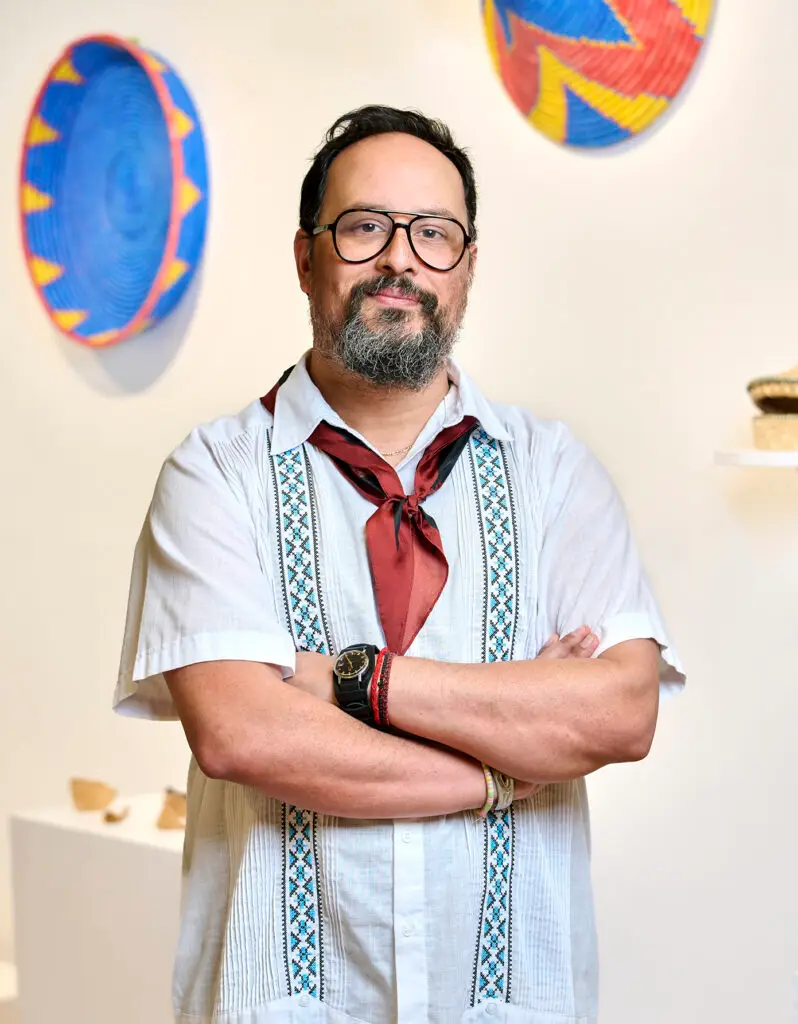
NSCAD welcomes its latest Canada Research Chair, Dr. Joshua Schwab-Cartas, who is now a CRC (Tier 2) in Global Indigenous Cultural Practice.
Schwab-Cartas, an assistant professor teaching in NSCAD’s Master of Art Education program, is a mixed-race Indigenous Binnizá (Zapotec)-Austrian researcher, filmmaker, parent, and language revitalization advocate.
For over two decades, he has worked alongside Indigenous youth and Elders in his maternal grandfather’s community of Unión Hidalgo in the southern Mexican state of Oaxaca and across numerous Indigenous communities throughout North America, bringing a deeply relational and community-rooted approach to research, pedagogy, and creative practice.
Since starting at NSCAD in 2022, Schwab-Cartas has been busy. He started a SSHRC- funded community research project called Living Our Language, which explored how visual arts could support Indigenous language revitalization. He began to connect with the Mi’kmaw Native Friendship Centre through food, offering hands-on traditional food preparation and cultural sharing. He also has been laying the groundwork for a participatory food sovereignty initiative connecting Mi’kmaq and Zapotec youth through food production, storytelling, and intergenerational learning.
“We are thrilled to announce Dr. Schwab-Cartas’s CRC appointment,” says NSCAD Provost and Vice-President, Academic and Research Kyla Mallett. “Josh has already contributed so much to the NSCAD community as a researcher and professor, and we are looking forward to supporting him as a CRC while he develops his Land Connects Us (LCU-Lab).”
Mallett says that Schwab-Cartas will be rolling out programming focused on community engagement and relationship building with and amongst Indigenous communities, noting that discussions are already underway about some exciting workshops and activities, including knowledge sharing and relationship building through food programming.
IN MEXICO OR CANADA INDIGENOUS PEOPLES ARE DEALING WITH SIMILAR ISSUES
This new research chair will move his community-based research initiatives forward in a big way, says Schwab-Cartas. He plans to build a working lab called Land Connects Us (LCU-Lab) to house a research and community initiative at NSCAD University that is dedicated to supporting Indigenous language and cultural reclamation through art-based practice and collaborative learning.
The goal of the five-year chairship is to bring together Indigenous students, youth, Elders, artists, and scholars from across Atlantic Canada, Mexico, and beyond to explore how creative practices—such as cooking, beading, weaving, storytelling, and digital media—can strengthen cultural continuity and intergenerational knowledge sharing.
“One of my longstanding research goals has been to foster connections among Indigenous nations by creating opportunities for us to learn from one another within our own cultural contexts and environments. This is not about promoting a pan-Indigenous framework, but about encouraging mutual understanding while respecting the distinctiveness of each nation.” he explains. “It’s about diversifying and decolonizing these ways of thinking, especially across places like Turtle Island, where colonial powers imposed artificial borders that continue to be reinforced through nationalist politics. Part of this work is also about breaking through the linguistic and cultural boundaries those systems created, so Indigenous nations can engage with one another more freely on our own terms.”
Indigenous peoples have been relating to one another for millennia, and this long history of trade and exchange is being relearned now. Cultural exchange is a way of reclaiming relationships that have been eroded and destroyed by colonialism.
“Whether it is in Mexico or in the United States or Canada, we’re always dealing with similar issues, whether that’s land extraction and resource extraction, or just neocolonial politics that want to continue to erase our identity and our ways of being.”
That was his experience as a student at McGill and University of British Columbia, studying alongside Indigenous students from around the world. He’d notice certain traditions and ceremonies were similar but different, and the variations fascinated him.
“Over time, you start learning we’re all the same – differently. And that’s what I want to pursue here.”
‘IF WE WORK TOGETHER, WE CAN DO SOME PRETTY INCREDIBLE THINGS TOGETHER.’
Schwab-Cartas envisions the LCU-Lab as a hub for cultural and creative exchanges between his community and Mi’kmaq communities, involving his peers but – especially – looking to young people to lead the charge.
“That’s always been a goal of mine, to get Mexican Indigenous youth here, and have Indigenous youth from Canada going to Mexico because I don’t think that either side has the full picture.”
It’s an opportunity to dismantle stereotypes and put colonial histories into question. His hope is that they will recognize the similarities and realize, “if we work together, we can do some pretty incredible things together.”
Food culture is at the heart of Schwab-Cartas’ research, as both a material and a method to build the LCU-Lab into a social space to nurture these kinds of cultural and artistic exchanges.
“My late father was a chef, and food just kind of runs through my blood,” he says. “I want to look at food cultures and foodways and see how we can use that as the first initial bridge to make those kinds of connections.”
The CRC will allow him to blur the lines where culinary arts and Indigenous traditions start and end and expand the role of food culture within an art institution like NSCAD.
“I find that culinary arts are segregated to a trade school. Maybe there could be a future of having food on these art campuses in a more tangible way. I want more hands-on involvement, people actually getting their hands dirty, bringing in that Indigenous pedagogy of experiential learning, hands-on learning and observation.”
For example, he plans to continue a project he did for Nocturne: a medicine garden, ideally living full-time at NSCAD.
“I’m hoping that we could have the NSCAD student body take care of it, and we could figure out something where we could have Soup Fridays with Bannock to share with the larger NSCAD community.”
BUILDING AND NURTURING COLLABORATIVE RELATIONSHIPS OVER TIME
While he has been speaking with Mi’kmaw communities since his arrival in Mi’kma’ki, Schwab-Cartas realizes it takes time to establish trusted working relationships.
“Trust doesn’t come overnight,” he says. “It’s not just about showing up. It’s about really working and doing things.”
When there is a history of mistrust with a traditionally colonial institution like NSCAD, it’s really a practice of implementing long-term research approaches.
“That’s something that doesn’t happen enough in academia, period. But when you are working with Indigenous people, this is a relationship you want to build and nurture and continue in a cohesive and collaborative way over time.”
That’s the way he works with his own Zapotecan community, which he came to when he was 20 years old. His grandfather brought him into his community, but his grandparents and Elders taught him about his nation’s ceremonies, language, protocols – and their food ways.
“I went back with my grandfather and did it the right way,” he says. “I learned over 20 years of being connected to our community and doing things – it takes time. We all want to move fast. I wish we already had a working relationship with the Mi’kmaw Friendship Centre, considering how long NSCAD has been around, but you’ve got to start somewhere, right?”
HONOURING LAND RIGHTS, SOVEREIGNTY AND AUTONOMY OVER THIS TERRITORY
Schwab-Cartas refers to himself as a guest scholar in Mi’kma’ki, a term comes with important distinctions and responsibilities.
“I’m an unwelcome guest in the sense that the Mi’kmaw nation hasn’t formally invited me to their territory. I’m here, and just because I’m Indigenous, that doesn’t give me a pass.”
He needs to be conscious of what these Mi’kmaw protocols mean and learn them. That work is inherently built into this chairship and his lab.
“I have to do that work, just like if somebody from Mi’kma’ki comes to my community, there’s a certain protocol. It’s about honouring my land rights and their connection, and ultimately, their sovereignty and autonomy over this territory.”
Schwab-Cartas believes his CRC project is helping to meet the emerging need for space living between the academy and the community.
“I certainly want it to be a community space,” he says. “I also want it to be at times, an Indigenous-only space with designated hours. We need something that really formalizes this relationship and says, okay, this is an Indigenous space.”
MORE THAN EVER, WE NEED PEOPLE RIGHT NOW TO STICK TOGETHER
Schwab-Cartas is at the start of a long research path. The structure of his CRC project may seem straightforward, but it is complex in the intercultural processes behind it, and all the research he has done previously has led him to this big question: how do we actually do this?
“The driving idea behind the research we’re doing is how do we make enough space and understand different protocols without going that simple route and flattening everything for it to be easier or to expedite things quickly.”
For instance: how does he take protocols from Mexico and honour them when he displays Zapotecan work here, with artwork that has traveled multiple borders to get here?
“What’s our role? What does care look like? What if we have a Mi’kmaw person, we have a Tsimshian person together? They have similar but different protocols. How do we honor those at the same time within this space?”
His ancestors, and Mi’kmaq ancestors knew how to do this, he says. It will take time to recover these traditions, but taking a long-time outlook that stretches well beyond the five-year CRC lifespan is itself a decolonial act.
Schwab-Cartas sees this research chair as just one important step in a career-long series of acts of bringing many Indigenous peoples together and making their knowledge welcome in academia.
“Everything I’m doing is following the footsteps of all our ancestors who have really paved the way for us, to make it easier for us to be in these spaces. My goal is to look ahead for my daughter, for my daughter’s daughters, and see that there is room for equity. That there’s respect for our ways.”
More than ever, he says, Indigenous peoples need to come together over these issues, “because we’ll speak with a more unified and louder voice, and hopefully institutions and governments will start listening to the things we want to change.”